

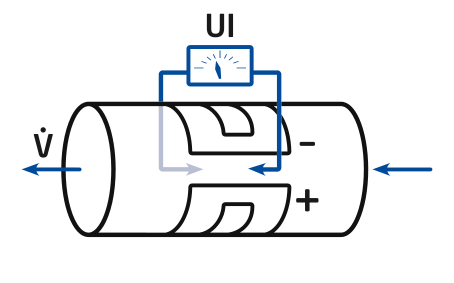
Electromagnetic flow meters measure the volume flow of electrically conductive liquids. Since there are no moving parts inside the measuring tube, they operate with minimal wear and cause virtually no additional pressure loss.
EMFs are particularly suitable for water, wastewater, chemicals, as well as contaminated and solid-laden liquids.
Advantages of Electromagnetic Flow Meters
- No moving parts
- Low pressure loss
- High measurement accuracy and repeatability
- Wide measuring range
- Suitable for contaminated and solid-laden media
- Largely independent of pressure, density, temperature, and viscosity
- Low maintenance requirements
excl. 19% VAT plus shipping costs
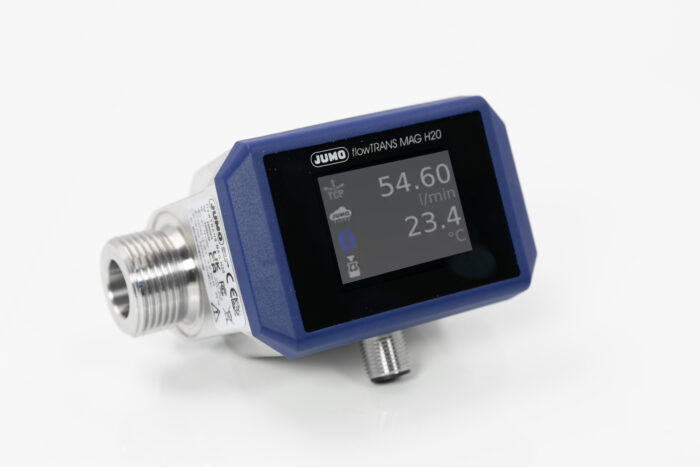
Measurement principle: Magnetic-inductive flow measurement (MID)
Nominal diameters: DN15 to DN25
Measurement range: 0.05 to 35 l/min (DN15) | 0.1 to 75 l/min (DN20) | 0.2 to 150 l/min (DN25)
Measurement accuracy: ±0.5% of the measured value
Repeatability: ±0.2%
Display: Integrated HMI display for showing process values
Outputs: 4 to 20 mA | 0 to 10 V | Pulse/frequency output | IO-Link
Electrical connection: M12 connector
Data Sheet: pdf | 1 MB
excl. 19% VAT plus shipping costs
Typical Applications
Electromagnetic flow meters are used in areas including:
- Water and wastewater technology
- Chemical and process industries
- Food and beverage industry
- Mechanical and plant engineering
- Dosing and filling systems
- Cooling and supply circuits
How an Electromagnetic Flow Meter Works
The measuring principle is based on Faraday’s law of induction. Coils generate a magnetic field perpendicular to the direction of flow. When an electrically conductive liquid flows through this magnetic field, a voltage is generated between two measuring electrodes.
This voltage is proportional to the flow velocity of the medium. The volume flow is determined from the flow velocity and the pipe cross-section. Measurement takes place without moving parts or components protruding into the flow.
Which Media Can Be Measured with an EMF?
Sufficient electrical conductivity of the medium is a prerequisite. Typical measurement media include:
- Water and wastewater
- Acids and lyes
- Conductive chemicals
- Sludge
- Pulp
- Solid-laden liquids
- Conductive food and beverage products
By selecting appropriate lining and electrode materials, EMFs can also be used for aggressive and corrosive media.
Limitations of the Measuring Principle
EMFs are exclusively suitable for electrically conductive liquids. Non-conductive or very low-conductivity media, such as many oils and hydrocarbons, cannot be measured.
Additional operational limits, such as minimum conductivity, temperature, pressure, and minimum flow velocity, depend on the specific flow meter.
Selecting an Electromagnetic Flow Meter
Key factors for selecting the right EMF include medium, conductivity, flow range, pipe diameter, pressure, and temperature.
We are happy to assist you in selecting the ideal electromagnetic flow meter for your specific application.
Consult Our Experts For Personalized Flow Meter Solutions
Contact us for advice on our flow meters and to find a customized solution for your individual requirements.