

Pressure sensors have established themselves as a leading testing technology for leak detection in water-glycol cooling circuits, enabling reliable and quantitative fault detection. Differential pressure sensors and gauge pressure sensors are primarily utilized for leak testing water-glycol cooling circuits.
Leak Testing via the Pressure Drop Method
The fundamental procedure for leak testing in water-glycol cooling circuits is the pressure drop method. In this process, the cooling circuit under test is pressurized to a defined test pressure, typically using dry air or nitrogen.
A high-resolution pressure sensor records the system pressure and detects even minimal pressure drops over a specified test time, which would indicate a leak in the circuit. The pressure drop can then be mathematically converted into a specific leak rate.
Challenges of Leak Testing via the Pressure Drop Method
A central challenge in this procedure is thermal influence, which alters the pressure inside the test specimen and can falsify the measurement results. To compensate for these influences and achieve high accuracy, our solution relies on differential pressure measurement, where the pressure in the test specimen is measured against a sealed reference volume. Here, it must be ensured that the test specimen and the reference volume share similar thermal characteristics.
Requirements for Pressure Sensors in Leak Testing
Media Resistance to Glycol Residues
For reliable operation, pressure sensors must exhibit high resistance to glycol residues or vapors within the cooling circuit. This is ensured through targeted material selection, where wetted parts such as the measuring diaphragm are manufactured from high-quality stainless steel (e.g., 1.4404 / 316L, 1.4435).
This is complemented by suitable sealing materials such as FKM or EPDM, which retain their tightness and elasticity even during permanent contact with aggressive media, thereby guaranteeing the long-term stability of the pressure sensor.
Required Pressure Type: Gauge, Absolute, or Differential Pressure
Choosing the correct pressure type is crucial for the accuracy of the leak test.
Absolute pressure sensors are rarely used in the field of leak testing, as fluctuating ambient atmospheric pressure must be metrologically compensated for.
For applications with limited installation space or for testing in the low-pressure range, the relative pressure measurement principle provides a common and robust solution.
For high accuracy requirements, particularly at high system pressures, we recommend differential pressure sensors. These measure the pressure drop in the test specimen directly against a reference volume set at the same pressure level, effectively compensating for environmental influences such as temperature fluctuations.
Measuring Range and Accuracy
The specific test pressure for cooling circuits is highly application-dependent and defined by the user. To guarantee optimal resolution, we offer the possibility to customize the measuring range of the pressure sensor to your specific application, allowing intermediate values such as 1.8 or 2.3 bar to be measured. Detecting the smallest leaks requires high precision and resolution, ideally better than 0.1% of the Full Scale value (% FS).
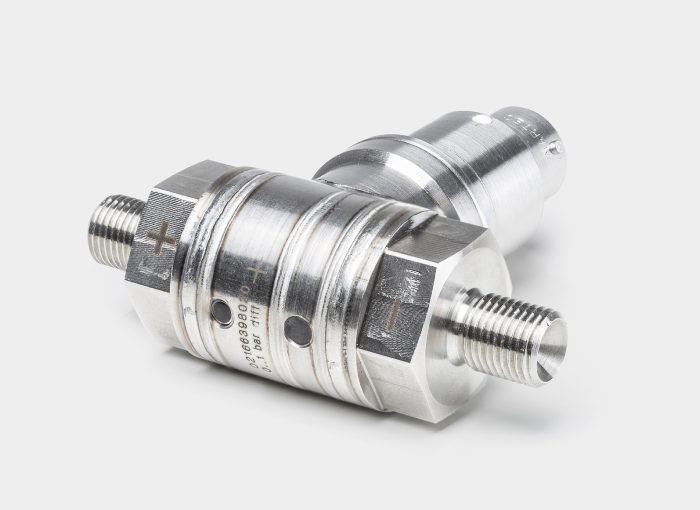
Our differential pressure sensors, such as the PX2722 with optional total errors down to ≤ 0,5 % v. of full scale (FS) and a typical long-term stability of ≤ 0,2 % v. FS per year, ensure the stability and low drift necessary for reproducible results.
excl. 19% VAT plus shipping costs
Ø: 27 mm
Measurement range: 100 mbar bis 3,5 bar (Any ranges in between; Bidirectional)
Output: 4 – 20 mA
Comp. Temperature Range: 0 to +50°C, -20 to 80°C or -40 to 125°C
Pressure connection: M10x1
Datasheet : pdf | 2 MB
excl. 19% VAT plus shipping costs
Temperature Range and Compensation
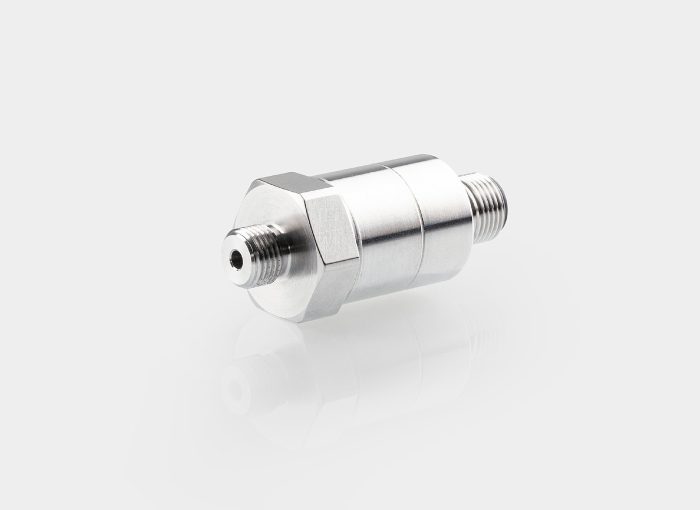
Since leak tests often take place under varying environmental conditions, a wide, temperature-compensated operating range of the sensor is indispensable. This is the only way to ensure measurement accuracy even under fluctuating temperatures. Our pressure sensors suitable for this application, such as the PV22, PV2722, and PX2722 series, feature a very wide operating temperature range from -40 to +125 °C as standard. This span guarantees reliable and stable measurement results across the entire relevant operating temperature range.
excl. 19% VAT plus shipping costs
Ø: 22 mm
Gauge pressure: 100 mbar to 150 bar (Any ranges in between; Bidirectional)
Absolute pressure: 2 bar to 150 bar (Any ranges in between)
Output: 0 to 5 V or 1 to 6 V
Comp. Temperature Range: -40°C to +125°C
Pressure connection: M10x1; M14x1,5; 7/16 – 20UNF; G1/4 male; Rectus 21
Datasheet : pdf | 271 KB
excl. 19% VAT plus shipping costs
excl. 19% VAT plus shipping costs
Ø: 27 mm
Measurement range: 100 mbar bis 3,5 bar (Any ranges in between; Bidirectional)
Output: 0 to 5 V or 1 to 6 V
Comp. Temperature Range: 0 to +50°C, -20 to 80°C or -40 to 125°C
Pressure connection: M10x1
Datasheet : pdf | 368 KB
excl. 19% VAT plus shipping costs
excl. 19% VAT plus shipping costs
Ø: 27 mm
Measurement range: 100 mbar bis 3,5 bar (Any ranges in between; Bidirectional)
Output: 4 – 20 mA
Comp. Temperature Range: 0 to +50°C, -20 to 80°C or -40 to 125°C
Pressure connection: M10x1
Datasheet : pdf | 2 MB
excl. 19% VAT plus shipping costs
Optimal Integration of the Pressure Sensor into the Cooling Circuit
When integrating a pressure sensor into a cooling circuit test setup, available installation space is frequently the deciding factor. To enable simple and space-saving implementation, we recommend our miniaturized pressure sensors. Models like the PV22 feature extremely compact dimensions of, for example, ø 22 x 33-45 mm. This footprint allows for flexible positioning directly on the test specimen without unnecessarily expanding the setup.
Performing a Leak Test with the Pressure Drop Method in 4 Steps
A typical leak test using the pressure drop method is structured into 4 clearly defined phases:
- Filling Phase
- Stabalization Phase
- Measuring Phase
- Venting Phase
In our guide for leak testing via the pressure drop method, the phases of leak testing are detailed comprehensively.
The Optimal Sensor Solution from DDM Sensors
With expertise in miniaturized pressure sensors and as an ISO 9001 certified partner for demanding testing applications, DDM Sensors offers precise and reliable solutions for leak testing water-glycol circuits. For this challenging application, we highly recommend our PV22, PV2722, and PX2722 product series. Thanks to diverse configuration options, we can tailor pressure ranges, electrical connections (e.g., M12, MIL connectors), and output signals (e.g., 0–5 V, 4–20 mA) exactly to your testing application. Our experts are available to assist you with detailed technical alignment.
Consult Our Experts for Personalized Pressure Sensor Solutions
Contact us for advice on our pressure sensors and to find a customized solution for your individual requirements.