


Pressure measurement in aggressive gases such as chlorine, ammonia, or hydrogen places the highest demands on the material resistance and longevity of the sensors used. DDM Sensors provides application-specific pressure measurement technology and targeted solutions for these requirements.
Our pressure sensors for aggressive gases in detail
Our portfolio includes a range of pressure sensors specifically designed for use in aggressive gases.
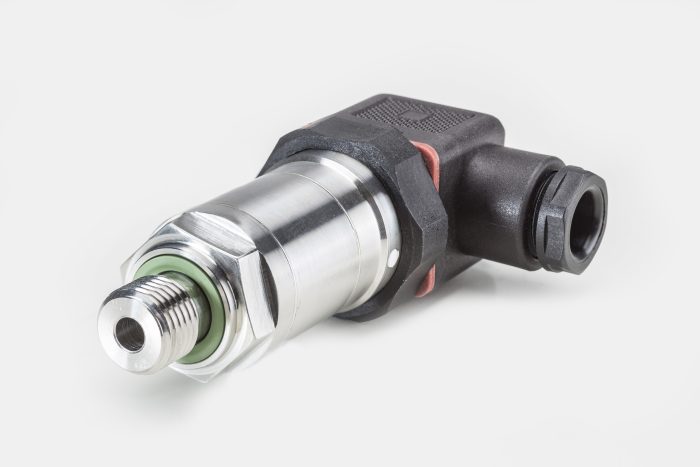
Model PX25H: The robust all-rounder for the process industry
The PX25H model is a robust all-rounder for the process industry, whose media-contacting parts are made of materials 1.4404 and 1.4435 (316L) and installed in a fully welded, seal-free construction. It covers measuring ranges from 0-100 mbar to 0-150 bar and is characterized by high accuracy of up to ±0.02% FS, excellent long-term stability, and a wide range of applications.
excl. 19% VAT plus shipping costs
Ø: 25 mm
Gauge pressure: 100 mbar to 150 bar (Any ranges in between; Bidirectional)
Absolute pressure : 250 mbar to 150 bar (Any ranges in between)
Output: 4 to 20 mA
Comp. Temperature Range: -20°C to +80°C
Pressure connections: G1/4″ female , G1/4″ male to DIN 3852 T11
Datasheet : pdf | 283 KB
excl. 19% VAT plus shipping costs
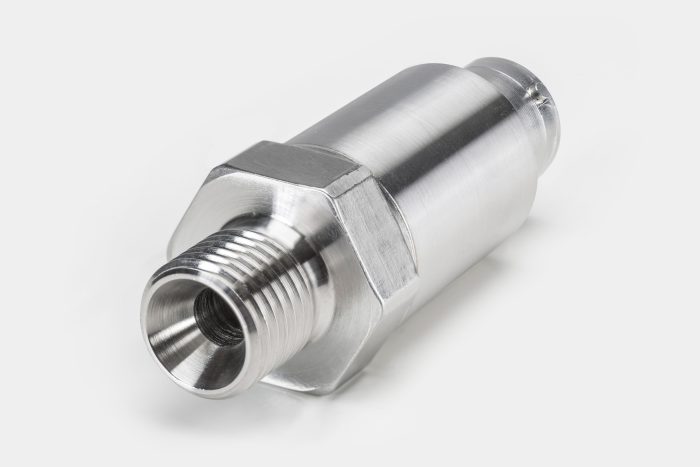
Model PV22H2: The specialist for hydrogen applications
excl. 19% VAT plus shipping costs
Ø: 22 mm
Gauge pressure: 0 to 4 bar (other pressure ranges on request)
Absolute pressure: 0 to 5 bar (other pressure ranges on request)
Output: 0 to 5 V or 1 to 6 V (others on request)
Comp. Temperature Range: -40°C to +125°C
Pressure connections: M10x1; M14x1,5; 7/16 – 20UNF; G1/4
Datasheet : pdf | 228 KB
excl. 19% VAT plus shipping costs
The PV22H2 hydrogen pressure sensor was developed for hydrogen applications, its media-contacting parts consist of 316L with proven hydrogen suitability. This also fully welded and seal-free model is designed for a temperature range of -40 °C to +125 °C and, with its high temperature resistance and compact design, is ideally suited for fuel cells and H2 systems.
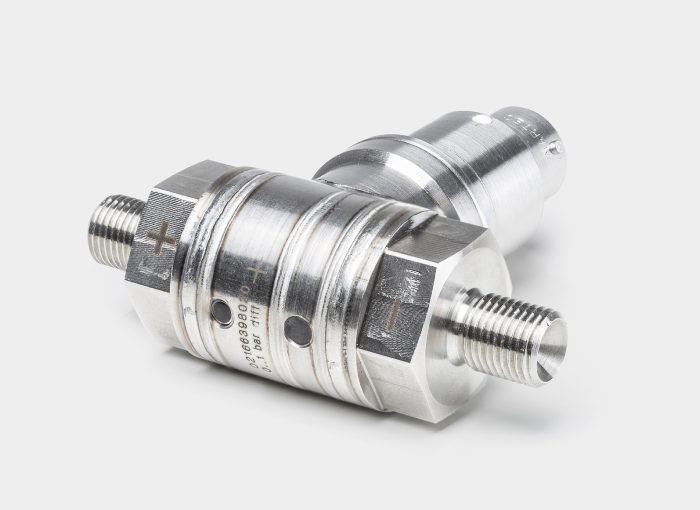
Model PV2722: Precise differential pressure measurement in gases
Model PV2722 is used for precise differential pressure measurement, covering measuring ranges from 0-100 mbar to 0-3.5 bar differential pressure. With media-contacting parts made of 1.4404 and 1.4435 (316L) and a fully welded design, it is the ideal solution for filter monitoring or flow measurement in systems with aggressive gases.
excl. 19% VAT plus shipping costs
Ø: 27 mm
Measurement range: 100 mbar bis 3,5 bar (Any ranges in between; Bidirectional)
Output: 0 to 10 V or 1 to 6 V
Comp. Temperature Range: -20 to 80°C
Pressure connection: M10x1
Datasheet: pdf | 368 KB
excl. 19% VAT plus shipping costs
Technical specifications at a glance
The following table summarizes the most important technical features of the pressure sensor models presented for better comparability.
| Feature | Model PX25H | Model PV22H2 | Model PV2722 |
|---|---|---|---|
| Application focus | Process industry | Hydrogen applications | Differential pressure measurement |
| Wetted material | 1.4404 (316L) | 1.4404 (316L) | 1.4404 (316L) |
| Design | Fully welded, seal-free | Fully welded, seal-free | Fully welded, seal-free |
| Measurement type | Gauge pressure, absolute pressure | Gauge pressure, absolute pressure | Differential pressure |
| Measuring range | 0–100 mbar to 0–150 bar | 0 bar to 5 bar | 0–100 mbar to 0–3.5 bar |
| Accuracy | ±0.1% of FSUp to ±0.02% of FS | ±0.25% of FS over temperature range -40 to +125°C | ±0.5% of FSUp to ±0.1% of FS |
| Special feature | Wide range of applications | For fuel cells & H₂ systems | Filter monitoring, flow measurement |
With which aggressive gases are the parts of the pressure sensors that come into contact with the media compatible?
The sensors are designed for a wide range of aggressive gases, whose compatibility results from the high resistance of the materials 1.4404 and 1.4435 used. These include media such as
- Chlorine
- Ammonia
- Sulfur dioxide
- Hydrogen chloride
- Hydrogen
Areas of application for pressure sensors with aggressive gases
The specialized pressure sensors are used in a wide range of demanding areas. The primary areas of application include hydrogen applications, such as those found in fuel cell technology or in H2 infrastructures. They are also widely used in the chemical industry, for example in micro-reaction technology or in gas chromatography equipment.
Design and material selection for aggressive gases
DDM relies on stainless steel 1.4404 and 1.4435 (316L) as the proven basis for a wide range of aggressive gases. Maximum media separation is ensured by a consistently seal-free and fully welded design, in which all parts that come into contact with the media are hermetically sealed together. The tightness of each individual sensor is verified by a 100% helium leak test during the manufacturing process. For particularly corrosive gases and extreme requirements, special materials such as special alloys (e.g., Hastelloy) or titanium are also available on request.
Quality and reliability for your application
The technological core of DDM sensors is analog signal processing. Compared to purely digital solutions, this offers decisive advantages such as
- Highest resolution
- Excellent accuracy
- Outstanding long-term stability
For legal protection and complete documentation, material certificates in accordance with EN 10204 3.1 are available on request for all parts that come into contact with media.
These ensure complete traceability and confirm the exact chemical composition of the material used. To ensure 100% tested quality, each individual sensor undergoes active temperature compensation and final calibration during the manufacturing process. This process ensures the specified accuracy across the entire operating temperature range.
Customized pressure sensors for aggressive gases
As your partner for the design and manufacture of customized pressure sensors, we develop solutions that are precisely tailored to your application. The customization options are diverse and include the use of special materials such as titanium for maximum chemical resistance, as well as the implementation of customer-specific measuring ranges and electrical output signals, for example 4-20mA, 0-10V, or ratiometric signals. In addition, mechanical process connections can be adapted and the housing design modified to enable miniaturization for particularly tight installation spaces.
Get advice on pressure sensors for aggressive gases now
Our experts are available to discuss your specific requirements in detail and configure the optimal sensor for you.