

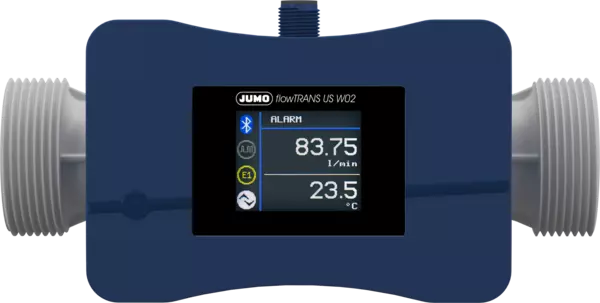
Ultrasonic flow meter with display (temperature) JUMO flowTRANS US W02


flowTrans US W02
Standard
PPSU
G1" (DN15)
G1 1/4" (DN20)
G1 1/2" (DN25)
G2" (DN32)
EPDM
Pulse, 4-20mA
Standard
Standard
None
Standard
Individual request
Is your specific configuration not listed, are you looking for a special solution or do you need large quantities? Our team is looking forward to your individual task.
Please write to us.Functional description
The JUMO flowTRANS US W02 ultrasonic flowmeter enables precise and reliable measurement of the volume flow of conductive and non-conductive liquids. The integrated TFT display shows the current measured values directly on the device and enables easy monitoring of the system on site.
In addition to the flow, the sensor can also measure and display the temperature of the medium. This allows two important process variables to be monitored at a single measuring point, reducing the number of additional sensors required in the system.
Flow measurement is performed using the proven ultrasonic transit time method. Since the measuring principle works without moving parts, the flow meter is particularly wear-free, low-maintenance, and durable.
The sensor is ideal for industrial applications such as water treatment, cooling circuits, reverse osmosis systems, or process plants and can be easily integrated into existing automation systems.
Advantages of the ultrasonic flow meter
- Wear-free flow measurement without moving parts
- Suitable for conductive and non-conductive liquids
- High measurement accuracy thanks to ultrasonic transit time measurement method
- Measurement of up to three process variables: flow, temperature, and pressure (optional)
- IO-Link and digiLine for integration into sensor networks
- Easy configuration via Bluetooth and app
- Corrosion-resistant, metal-free housing
- Low-maintenance inline installation in pipelines
Functional principle of ultrasonic flow measurement
The flow meter operates according to the time-of-flight difference method. Two opposing ultrasonic sensors transmit sound pulses through the medium—once in the direction of flow and once against the direction of flow.
When the medium is flowing, the transit time of the ultrasonic waves changes. The average flow velocity is calculated from this transit time difference, and the volume flow is determined from this. This method enables precise flow measurement without mechanical components and thus particularly high long-term stability.
Typical areas of application
- Water treatment
- Reverse osmosis systems
- Seawater desalination
- Washing water recovery
- Cooling circuits and cooling towers
- Wastewater and process plants (e.g., electroplating or surface treatment)
Product details
Nominal pressure
Downloads
Related products
-
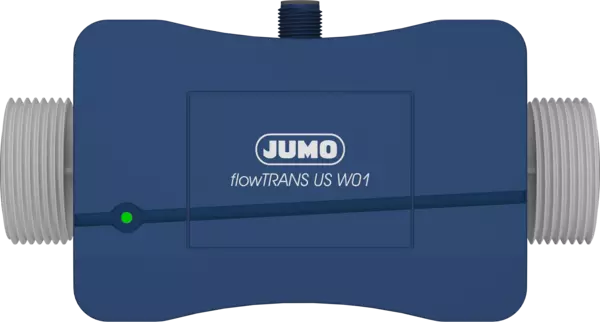
flowTrans US W01 – Ultrasonic flow meter
From 500,00 €excl. 19% VAT
plus shipping costs
Select options